


20 years of experience at your service in protection
consulting and training in Explosive Atmospheres
Added to cart
There are no products in the basket
(DOWNLOAD E-BOOK VERSION HERE)
1. Introduction
Bucket elevators are one of the main equipments used for transport of bulk solids in various types of industrial sectors: grain handling, breweries, feed mills, feed mills or the food industry, among others.
In addition to the above, elevators represent one of the main explosion risks zones in industries where flammable dusts are handled, mainly due to their high propensity to gcreate ignition sources of different origin.
This is why it is really important to carry out a correct assessment of explosion risks in installations that use this type of equipments, with the aim of reducing the probability of an explosion occurring, and if it does occur, that its consequences are minimal, avoiding material and human damage.
There are several standards used at international level to be able to carry out a correct risk assessment, the most important of which include:
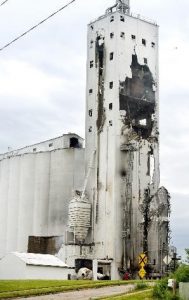
Fig.1 Explosion of bucket elevator (ref. Https//siouxcityjournal.com)
2. Explosion risk assessment
A proper explosion risk assessment must include at least the following points:
2.1. Classification of potentially explosive areas in bucket elevators
It is common to consider the equipment as an indoor area due to its high operating speed and high probability of continuous generation of dust clouds in flammable concentration but also due to the possibility of accumulation of dust layers adhering to the walls that may become suspended.
Effective ignition sources:
Sources of ignition produced by the hoist itself, such as:

Fig.2 Hot bearing surfaces (ref. https://bulkhandlingtoday.co.za)
2. Ignition sources from interconnected equipments, e.g. hot particles or explosions as well as ignition sources produced by electrical equipment outside the lift.
3. External ignition sources due to maintenance, welding, cutting (hot work), smoking in the installation or deflagrations from other equipment. Such ignition sources are prevented by organisational measures.
4. Ignition sources produced by the product to be transported itself, e.g. due to self-combustion of dust accumulations inside the lift.
3. Recommended prevention and protection measures
In view of the possible presence of explosive atmospheres on an almost continuous basis and the variety of ignition sources that can be effective, the probability of an explosion occurring in a bucket elevator is high and its consequences can be catastrophic for installations and persons.
This is why both explosion prevention and explosion protection measures are considered necessary in this equipment, among which we must consider the following ones.
3.1. Prevention measures

3.2. Protection measures
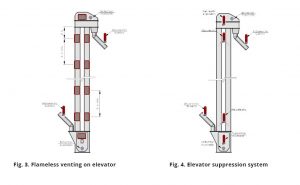
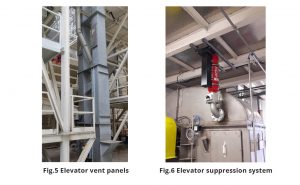
Note: The implementation of protection systems on bucket elevators should follow a recognised standard or guide (e.g. technical report CEN/TR 16829, VDI 2263 or NFPA 61).